
Mugginess
On some warm days in New Zealand, especially when humid subtropical air moves in from the north, the air can feel heavy, sticky, and hard to cool down in. That’s what we call mugginess.
To understand why it feels that way, we need to talk about two things: relative humidity and dew point temperature.
Relative humidity tells us how close the air is to the point where water vapour will start to condense into liquid water droplets, for example, into dew or fog. This point is known as saturation. When the air reaches 100% relative humidity, condensation and evaporation are balanced, and the air can’t take on any more moisture without some of it condensing into liquid water.
But here’s the catch: cool air reaches saturation with much less water vapour than warm air. That’s why a cold morning can have 100% relative humidity but not feel muggy; the total moisture in the air is still quite low.
To get a better sense of how much water vapour is actually in the air and how muggy it’s likely to feel, we use dew point temperature. This is the temperature the air would need to cool to for condensation to start. A higher dew point means that there is more moisture in the air.
Mugginess happens when:
It’s warm enough to make us sweat, and
The dew point is high, meaning there’s a lot of moisture in the air.
So, why does mugginess make us feel uncomfortable? Under usual conditions, sweating helps us cool down by evaporation. But when the air already holds a lot of water vapour, sweat can’t evaporate as easily, so we stay hot, sticky, and uncomfortable.
So, while relative humidity tells us how close the air is to being “full,” dew point tells us how much moisture is actually there, and how muggy it’s likely to feel.
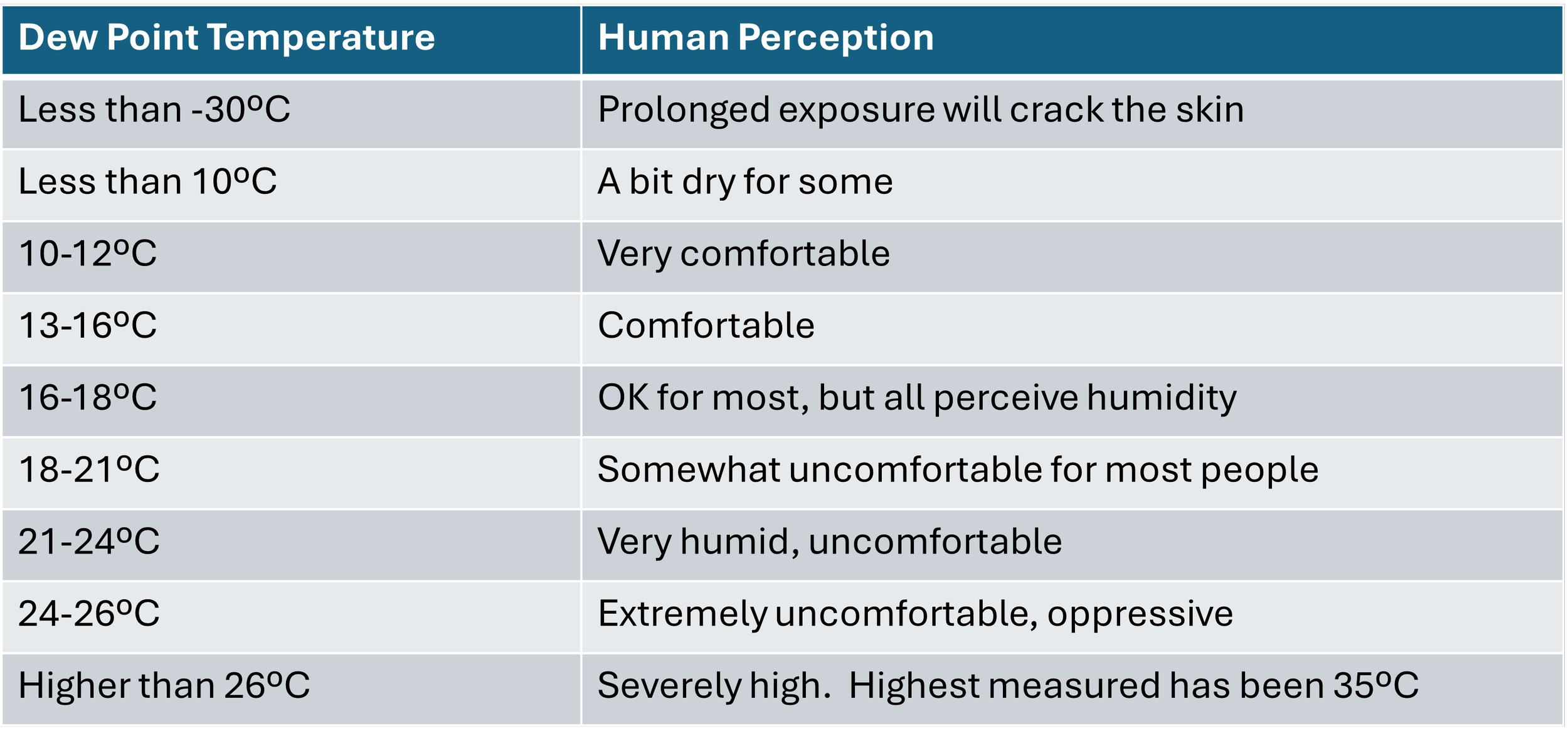
The following table was put together by Steve Horstmeyer of WKRC TV (Ohio, USA) to help link dew point temperature to human experience of humidity:
Note
Condensation: when water vapour turns into liquid water (like dew or fog forming)
Evaporation: when liquid water turns into vapour and enters the air (like sweat drying)