
Altocumulus Lenticularis
Latin Translation
Alto = “high” or “elevated”
Cumulus = “heap” or “pile”
Lenticularis = “lens-shaped”
Height
Between 6,500 to 23,000ft (~ 2000 to 7000 metres) in mid-latitudes.
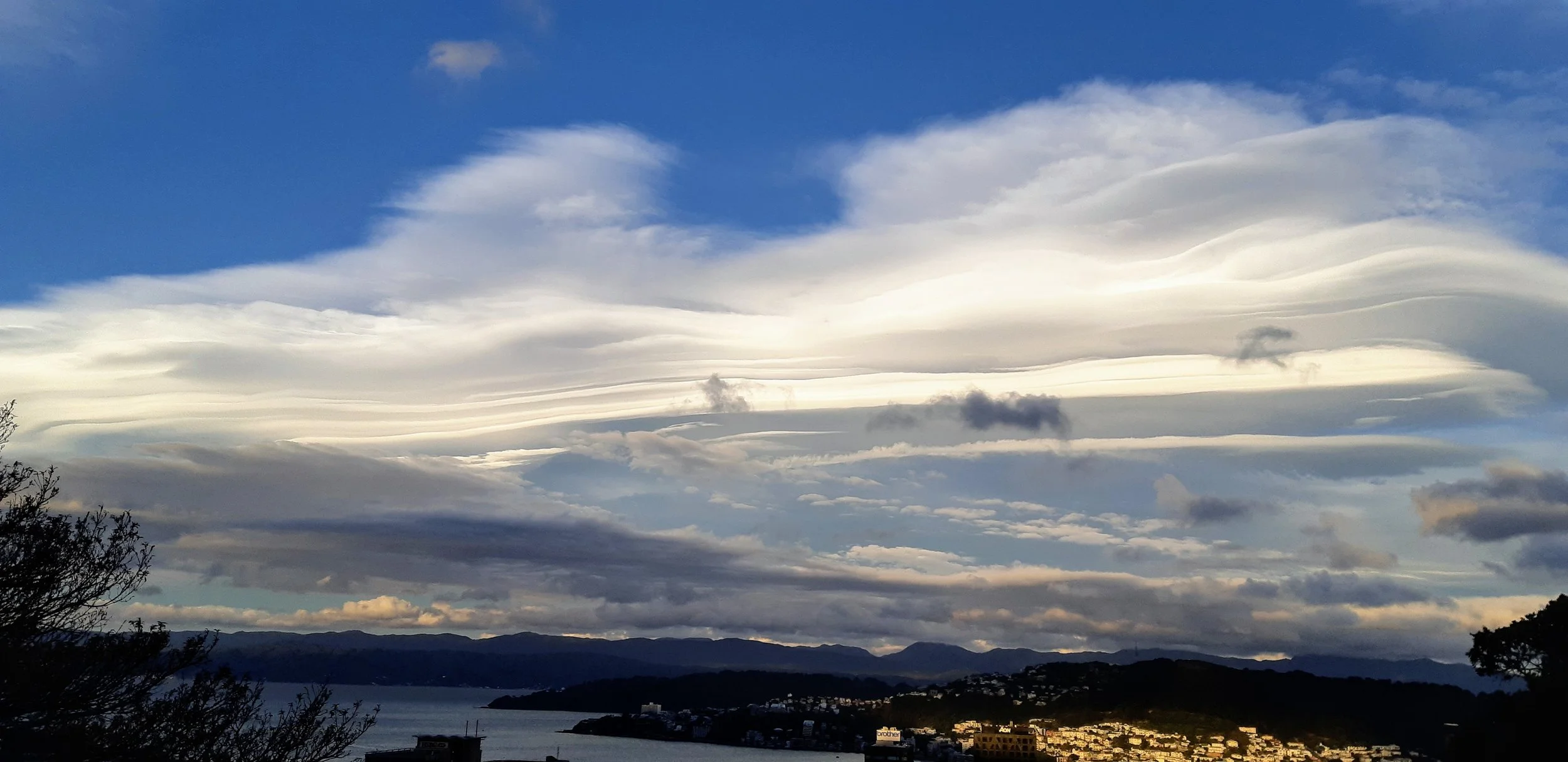
A lenticular cloud over Wellington Harbour. The clear white colour and very smooth, ‘stacked’ shape is characteristic of lenticular clouds; contrasted with the grey fluffy stratocumulus.
About
Altocumulus Lenticularis clouds are stationary mid- to high-level clouds found in mountainous environments. They are smooth, bright clouds that are wide but not very tall. Sometimes they will stack on top of each other and look like a UFO.
How do they form?
When air is pushed against a mountain, some of it is forced upwards. As it gets pushed up, it cools down, and the water vapour within the air condenses into microscopic water droplets which forms clouds.
Sometimes, there is an invisible atmospheric lid (such as a region of high pressure that the lower-pressure air can’t push aside). If this lid is at a height just above the mountain top, then the cloud is squeezed through the gap, causing the cloud to become stretched wide and flat.
On the downwind side of the mountain, the air descends. As it does, it warms up and the microscopic water droplets evaporate back into water vapour, clearing the cloud from lower levels. This leaves a wide, flat altocumulus lenticularis cloud over the mountain top, like a hat.
Additionally, mountain environments can cause the air to create waves downstream. Air travelling through these waves is going up and down, and the effects are the same as if it was being forced over a mountain, with air condensing at the top of the wave and evaporating at the bottom. Therefore, altocumulus lenticularis clouds can also be created downstream of mountains in the invisible wave crests.
How to spot them?
Luckily, there are plenty of opportunities to spot these clouds in Aotearoa New Zealand as they are formed in mountainous environments. They are wide and flat and have similar characteristics as a stack of pancakes and are sometimes mistaken for a UFO. Other times it looks like the mountain top is wearing a cloud hat!