

Aurora
In most atmospheric optical phenomena, the light has come from the sun, but sometimes from the moon, or city lights. Auroras are a different story. The lights of Aurora Australis (or Aurora Borealis in the Northern Hemisphere, or Northern Lights) are actually emitted by gas particles in the atmosphere itself.

Sun Pillars
Sun pillars are most commonly seen near sunset or sunrise. Sun pillars form in a similar way to light pillars, reflecting light off of ice crystals in the air.

Light Pillars
Like ice halos and arcs, light pillars are formed by ice crystals. However, the way they are formed is much less complex – light simply reflects off of ice crystals in the air.


22° Circular Halos
22° halos are created by refraction of light through randomly oriented hexagonal prism shaped ice crystals. These ice halos occur very frequently, even more often than rainbows! Light is refracted as it enters through one face of the hexagonal ice crystal, and is refracted once more as it exits through another face.
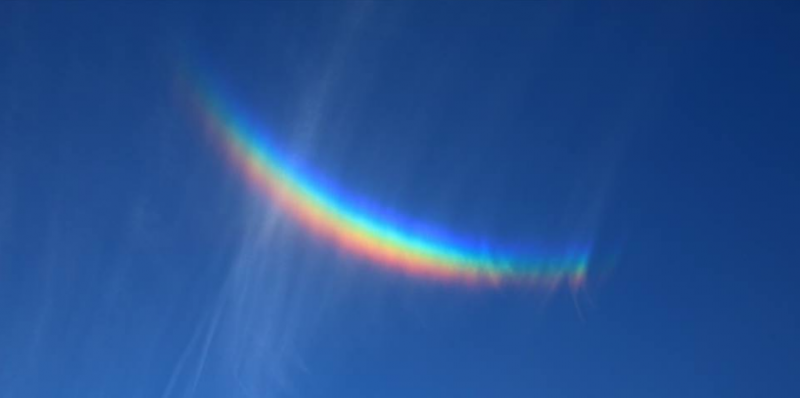
Circumzenithal Arc
Ice crystals can come in many different shapes and sizes. High up in the atmosphere, water can remain in its liquid phase well below 0°C (super-cooled liquid water), and the temperature at which it freezes has a great effect on the shape of the resulting ice crystal.


Cloud Irisation
Cloud irisation (also called iridescence) is caused by sunlight diffracting around cloud droplets. Diffraction is the bending of light as it passes between small gaps or past edges. For this to occur, the cloud droplets must be of a similar size to the wavelength of light.

Anti-Crepuscular Rays
Anti-crepuscular rays are similar to crepuscular rays, except you must be facing away from the sun to see them.
Like crepuscular rays, they are usually seen at sunrise and sunset, and the rays are formed by the sun shining between clouds.

Crepuscular Rays
Crepuscular rays (sometimes called Sun rays, God rays or Jacob’s Ladder) are rays of sunlight that are seen when the sun is partially obscured by cloud.
