
Convergence
In weather, convergence happens when air flowing from different directions meets. When this air comes together, it has nowhere else to go but upwards. That rising motion of air causes it to cool down, which can lead to clouds and rain. Convergence is a key part of how showers, thunderstorms, and cloudy weather form. It's something meteorologists keep a close eye on, as it helps pick out where active weather, like clouds, showers, storms, and even cyclones, is likely to form.
One common example of convergence in Aotearoa New Zealand is linked to sea breezes. On warm days, sea breezes blow in from both coasts in places like Northland and Auckland where the land is narrow. When those breezes meet in the middle, the air is forced upwards. This often forms clouds, showers, or even thunderstorms, if conditions are right!
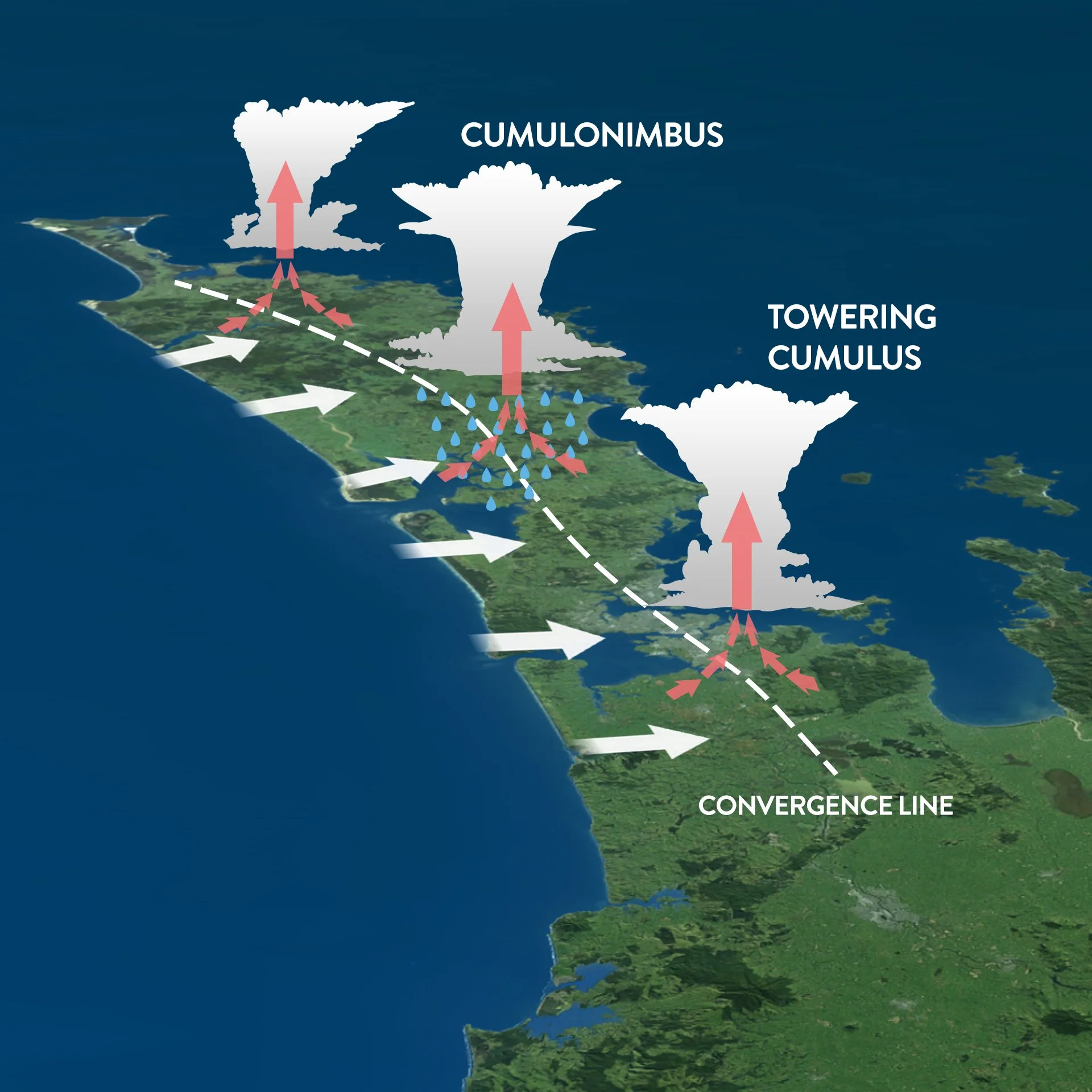
Sea breeze convergence forming cumulus and cumulonimbus cloud over the narrow land of Northland and Auckland (MetService, 2021)
The opposite of convergence is divergence, which happens when air spreads apart. This can happen at low levels (such as over the sea during a sea breeze when air is blowing away from the sea towards the land), or high up in the atmosphere. Where air is diverging near the ground, it often leads to clear skies, because the air above is sinking to replace it – and sinking air tends to stop clouds from forming.
Convergence in the wider Pacific
On a larger scale, there are zones in the tropics where warm, moist air flows together from both sides of the equator. The most well-known is the Intertropical Convergence Zone (ITCZ), where the Trade Winds meet and rise, creating a band of cloud and frequent rainfall.
Closer to Aotearoa New Zealand is the South Pacific Convergence Zone (SPCZ), which stretches from near Vanuatu through the Cook Islands. These tropical convergence zones shift position and intensity over time, and they play a big role in forming tropical cyclones and bringing rain to the wider Pacific region.