
Southern Annular Mode
There are several climate patterns that influence the distribution of weather around the world. The most widely discussed of these is the El Niño-Southern Oscillation (ENSO). However, it is the Southern Annular Mode, or SAM, that has the largest effect on how the climate varies in our part of the world: the Southern Hemisphere and Aotearoa New Zealand.
The word “annular” means ring-shaped. The Southern Annular Mode describes a ring of westerly winds and associated storms and fronts that encircles the South Pole and shifts in latitude between 40° and 65° South.
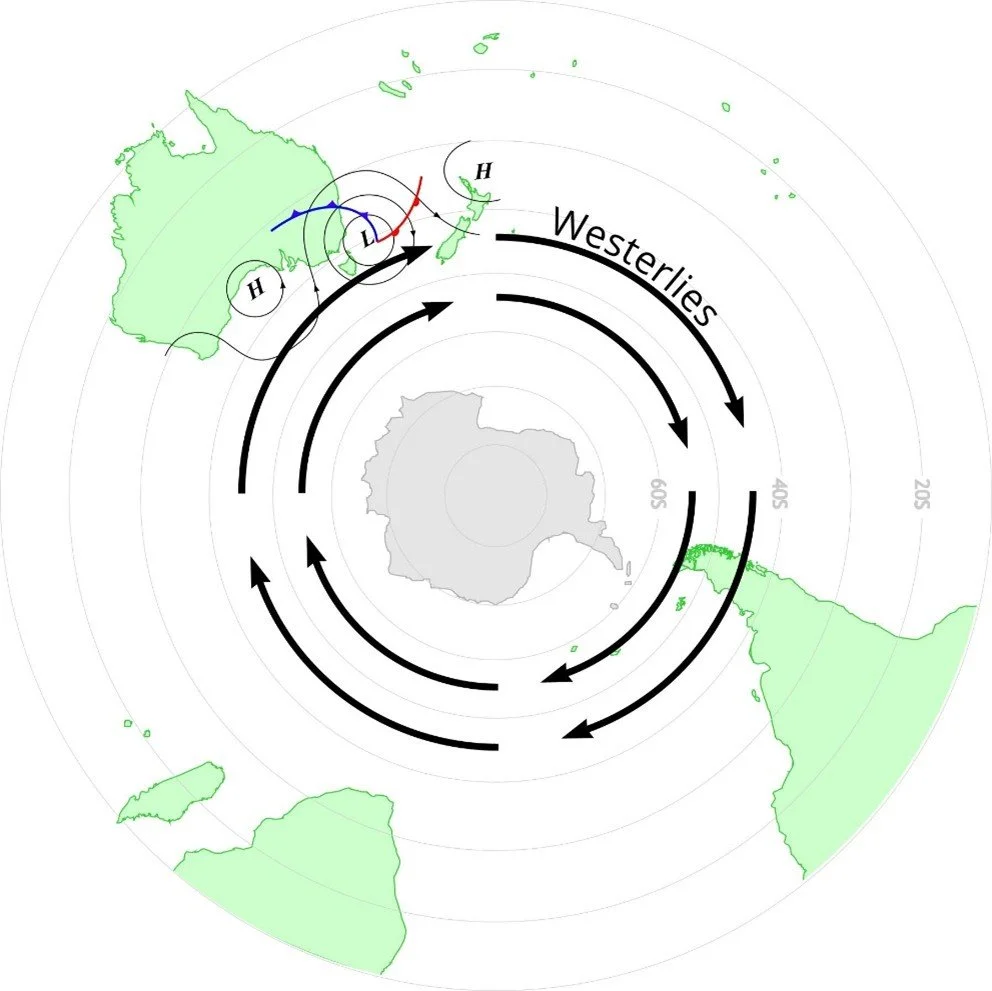
The ring of westerly winds in the Southern Hemisphere that represent the Southern Annular Mode (SAM)
There are three phases of SAM: positive, negative, and neutral. Each phase describes how this ring of winds gets smaller and stays closer to Antarctica or gets larger and covers more of the Southern Ocean. The phase of SAM will in turn change the strength of the winds and how often storms affect Aotearoa New Zealand.
Positive SAM
During a positive SAM phase, the ring of westerly winds and associated storms shrinks away from the Southern Ocean towards Antarctica. This brings more settled conditions and lighter winds to Aotearoa New Zealand, as well as warmer-than-average temperatures to western parts of the country.
Negative SAM
During a negative SAM phase, the ring of westerly winds gets larger and pushes northwards towards Aotearoa New Zealand. This increases the strength of westerlies across the country and makes them last longer, which in turn brings unsettled weather, and cooler-than-average temperatures to western parts of the country.
Neutral SAM
When SAM is in neither a positive or negative phase, it is said to be in a neutral phase, and the ring of westerly winds is in its average position over the Southern Ocean. This brings near-normal weather conditions for Aotearoa New Zealand.
SAM often changes between phases quickly and can be hard to predict. Because of this, SAM is difficult to forecast with any skill further than a week or two into the future. SAM will often stay in each phase for several weeks at a time; but climate scientists have found that over the past few decades, SAM has tended to be positive more often.
Fun fact, a similar climate oscillation happens in the Northern Hemisphere, called the Northern Annular Mode, or NAM. Unlike SAM, which happens in the ocean-filled Southern Hemisphere, the presence of large landmasses in the Northen Hemisphere interrupts the ring-shaped structure of NAM.