
Layers of the Atmosphere
The Earth’s atmosphere is made up of gases, water vapour, and tiny particles like dust, smoke, and sea salt. It stretches high above us and is divided into five main layers, seen below. But for weather, the most important parts are the ones closest to Earth’s surface: the troposphere and the bottom of the stratosphere.
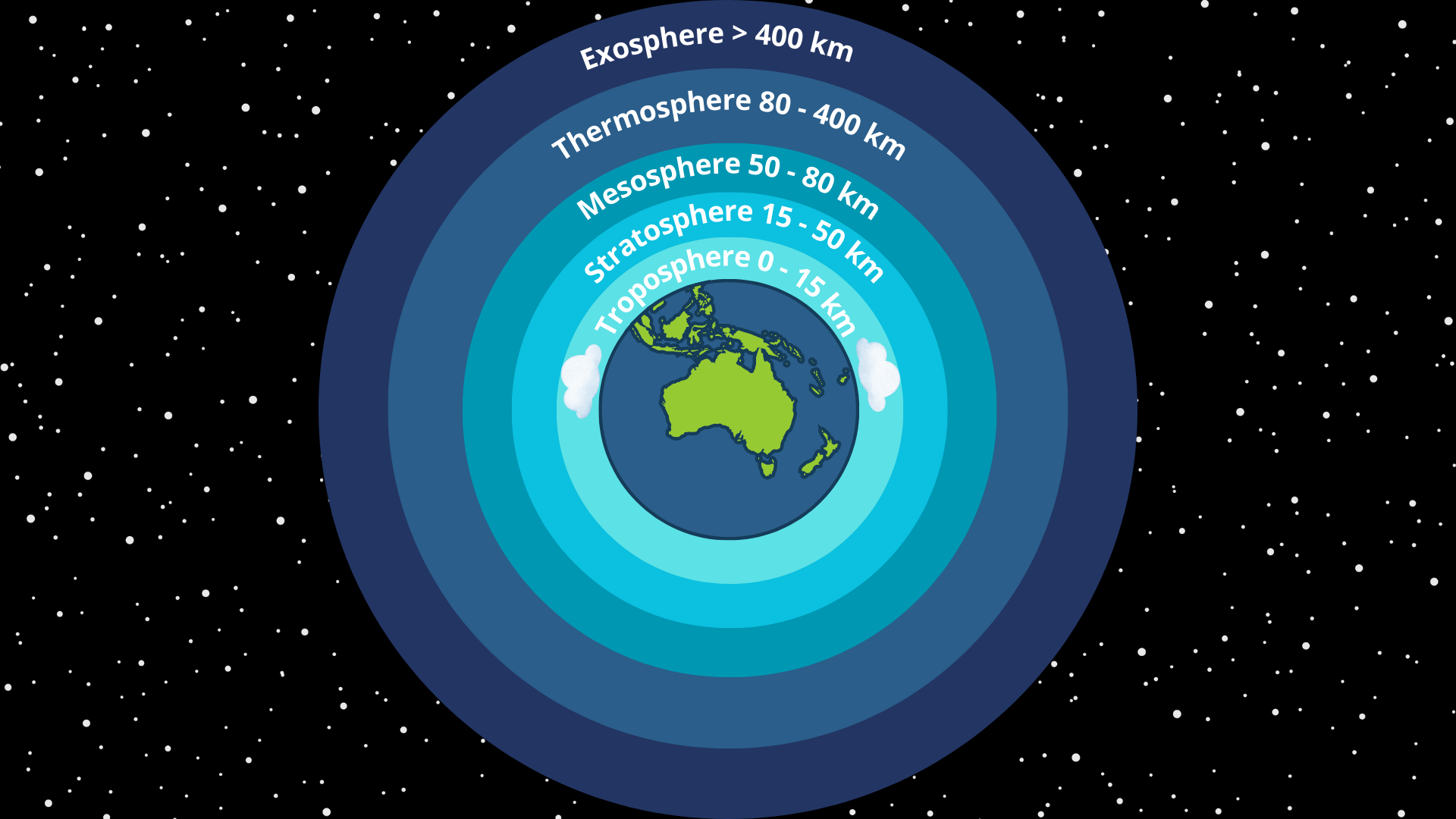
The layers of the atmosphere
The troposphere is where we live, and where nearly all weather happens. It’s also the layer that most planes fly through. This part of the atmosphere is packed with gas particles, especially near the ground, so it's the densest layer. As you go higher, both air pressure and temperature drop. But near the very top, temperatures stop falling for a bit and then start to rise. That turning point is called the tropopause, and it’s the boundary between the troposphere and the stratosphere.
Big storm clouds, like cumulonimbus, can stretch from the bottom to the very top of the troposphere, but they usually stop growing at the tropopause, like they’re hitting an invisible ceiling. Let’s take a closer look at what’s going on as we travel up through the troposphere.
At the surface – where we live
This is where we feel the full force of the weather, like sunshine, storms, snow, and more.
Air is thick and heavy here. It’s packed with gases and water vapour.
Temperatures can swing from hot to freezing, depending on the time of year and your location.
Weather is the most active here, and clouds come in all shapes and sizes, especially low ones like stratus (flat and grey) and cumulus (puffy and white).
It’s where we breathe the easiest and oxygen is most available near the ground.
3 km Up – Among the mountains
At this height, you're around the level of Aoraki / Mount Cook, New Zealand’s tallest mountain.
The air starts to thin out, so there are fewer gas particles in each breath.
It’s cooler, often between 5°C and minus 10°C.
Clouds can form and rise here like middle-layer clouds that stretch across the sky.
This level is still full of weather activity, especially in hilly or mountainous places where air gets pushed around to form cool looking clouds like altocumulus lenticularis (the one that looks like a flying saucer).
5 km Up – Rainy cloud zone
This is a busy level for weather.
The air is much thinner now, about half as dense as at the surface.
Temperatures drop further; think minus 25 to minus 15°C.
There’s less oxygen to breathe, but some people do live at these heights in places like the Andes or Tibet.
Clouds like altostratus hang out here.
Water in the clouds can be super-cooled, which means it's still liquid even though it’s below freezing.
10 km Up – Edge of the troposphere
Now we’ve reached the top of the troposphere, where the air is very cold and very thin.
It’s around minus 55°C, colder than most places on Earth.
The air is so thin that doing something like trying to blow up a balloon would take a lot more effort (and it would explode from the pressure differences).
Only ice crystal clouds survive up here, which we often see as cirrus clouds like wispy streaks across the sky.
This is the height at which long-distance planes fly.
Winds up here are incredibly strong; this is where the jet streams speed around the globe.
There’s barely any water vapour left, which makes it drier than a desert.
And beyond...
Above this level is the stratosphere, where the ozone layer is found. This layer doesn’t have much weather, but it protects us by blocking harmful ultraviolet rays from the sun, like sunglasses for the Earth. The word "stratosphere" comes from the Latin word for layer, just like the stratus clouds near the surface. Up here, everything becomes more layered and still.
What happens to the air as you go higher?
In summary, as we go up from the ground:
Air pressure drops
Temperature gets colder until it levels off near the top of the troposphere
Clouds change from big, puffy and rainy to thin, icy, and wispy (except the tops of the cumulonimbus clouds that can touch the tropopause)
Air gets drier and lighter since there’s less oxygen and less water vapour the higher you go
To be able to forecast, it’s important to have a good understanding of the different levels of the troposphere. Our weather forecasters spend a lot of time thinking about what’s happening both at the ground, as well as high above.