
Lightning
Have you ever walked across a carpet in woolly socks, touched a metal doorknob and felt a shock? That’s because you built up static electricity. Lightning works in a similar way, just on a much bigger scale.
Lightning is a very bright flash of electricity in the sky. It happens during thunderstorms and can be seen from far away.
How does lightning form?
It starts with a big thunderstorm cloud called a cumulonimbus. Inside the cloud, air moves up and down quickly in different areas. Tiny ice crystals and larger, soft hailstones called graupel bump into each other.
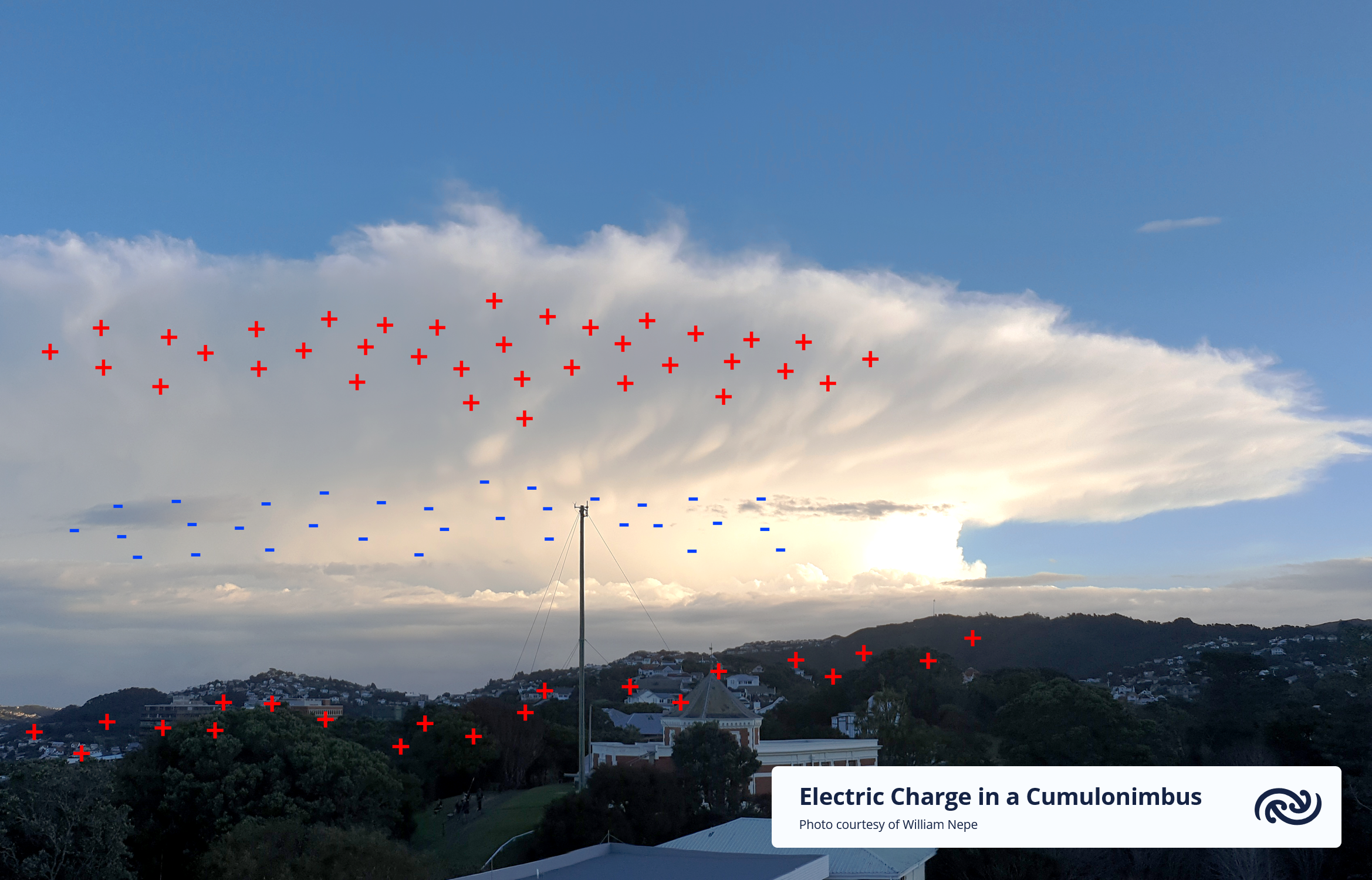
When these particles hit each other, electrons (tiny negative charges) are knocked off. The graupel, which is heavier, ends up with a negative charge and sinks toward the bottom of the cloud, while the lighter, positively charged ice crystals are carried upward by strong winds. This separation of negative and positive charges between the bottom and top of the cloud creates a powerful electric field within the cloud, like a battery. The spread of positive and negative charges is shown in the image below.
The ground below the cloud gets a positive charge too, in response to the negative charge at the base of the cloud. And remember, opposites attract! When the electric charge becomes strong enough, that attraction is enough to overcome the gap in the air and create an electric discharge, zapping through the air. This is what we know as lightning.
Types of Lightning
Lightning can take many forms, from forked, to spider, to sheet lightning and many more. But these only describe the differences in how lightning looks. There are technically three different types of lightning.
Intra-cloud: lightning that stays inside one cloud
Cloud-to-cloud: lightning that moves from one cloud to another
Cloud-to-ground: lightning that strikes the ground
The first two often look like flashes across the sky. The third is the classic lightning bolt that we usually imagine, from the cloud down toward the ground. Cloud-to-cloud lightning happens about five to ten times more frequently than cloud-to-ground lightning.
Lightning safety
Lightning is dangerous. The temperature inside a lightning bolt is around 30,000 °C, which is about five times hotter than the surface of the sun. A lightning bolt can carry a charge of 300 million volts, so someone struck by lightning is unlikely to survive.
Because lightning tends to take the shortest path to the ground, it often hits the tallest object or structure. That is why taking shelter under a tree during a lightning storm increases the risk of being hit.
One of the best places to be is inside a car. This is because the car acts as a shell of conductive material, with the lightning running over the car’s outside. Just don’t touch anything connected to the car’s outside. Similarly, inside a house is a safe place to be, just stay away from anything directly connected to the outside.
At MetService, weather forecasters look out for signs of thunderstorms and produce daily thunderstorm outlooks, highlighting potential threats from thunderstorms. When conditions in the atmosphere are right, weather forecasters also issue Severe Thunderstorm Watches and Severe Thunderstorm Warnings to help keep people safe.
All these are available on the MetService website