
Tropical Cyclone FAQs
What is a tropical cyclone?
A tropical cyclone is a low pressure system which forms over warm waters in the tropics (between 23.4° north of the equator, and 23.4° south). To be considered a tropical cyclone and not just a big storm, it needs to have gale force winds (63km/h or more) at low levels near the centre, with organised convection (i.e. rain bands and/or thunderstorm activity). The diagram below shows the structure of a tropical cyclone in the Southern Hemisphere.
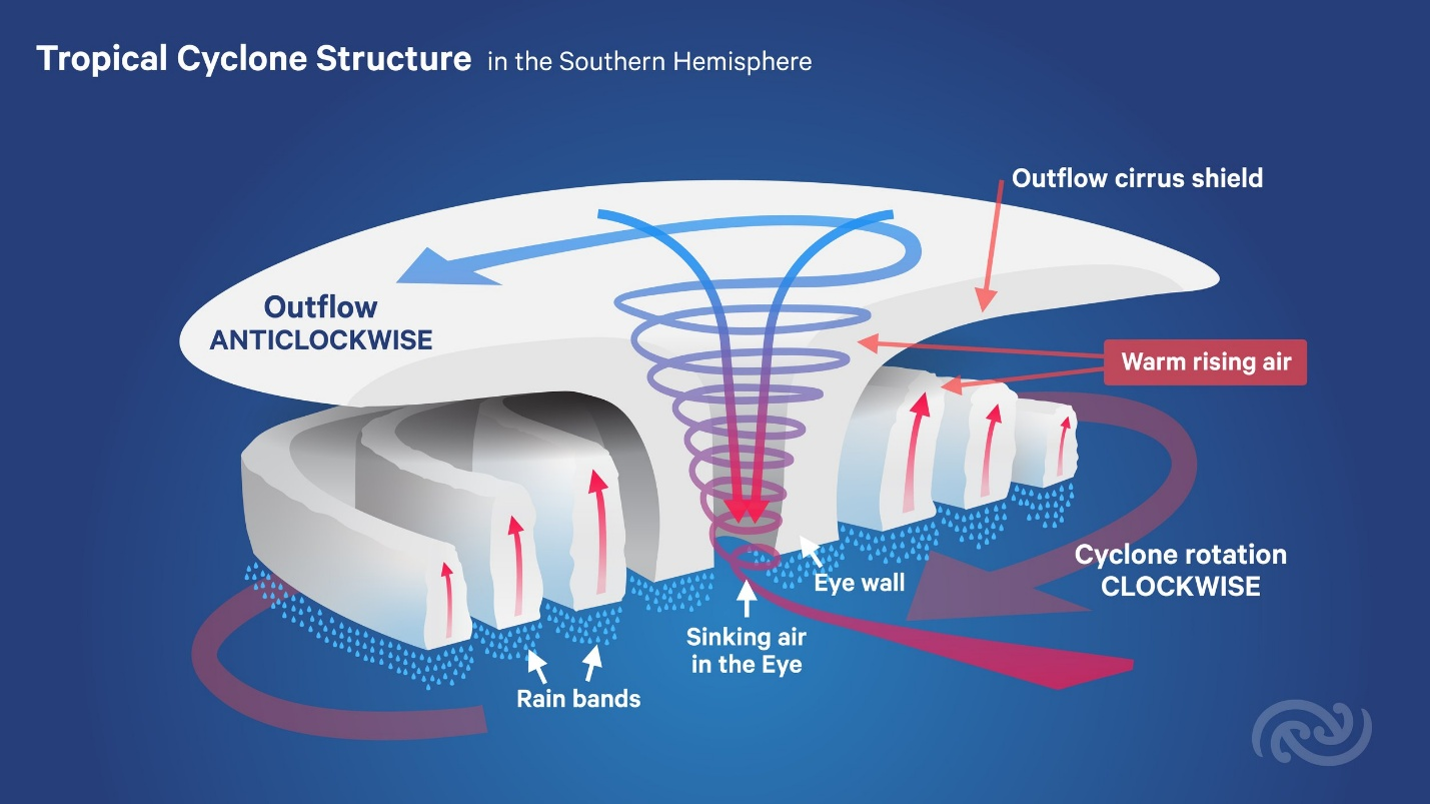
The gale force winds around the cyclone can spread out hundreds of kilometres from the centre (or eye) of the cyclone, and if the winds reach 64 knots (118km/h) then the system is called a severe tropical cyclone.
Severe tropical cyclones are named differently in other parts of the world. Here in the South Pacific and Australia they are known as Severe Tropical Cyclones, in the Northwest Pacific they are called Typhoons and in the North Atlantic and Northeast Pacific they are called Hurricanes.
What are the different categories of tropical cyclone?
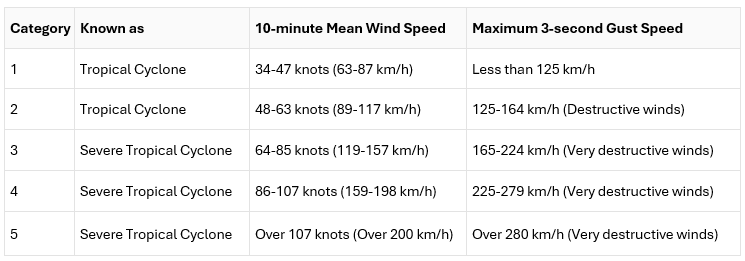
This table outlines how tropical cyclones are categorised under the Australian tropical cyclone intensity scale. The scale is used by the Fiji Meteorological Service and the Australian Bureau of Meteorology. Any tropical cyclones that impact us in New Zealand will have originated from these regions, but by the time they reach us, they’re no longer in the tropics and tend to have turned into a different type of low pressure system. That means we can’t use this scale to categorise them, but they can still be very destructive and dangerous storms.
When do we get tropical cyclones?
In the southern hemisphere, tropical cyclone season officially begins on 1 November, and ends on 30 April, with a peak in February. However, tropical cyclones can form outside of these dates; in 2023, Tropical Cyclone Lola formed on 19 October, and in 2018 Tropical Cyclone Liua formed on 26 September, the earliest formation of a South Pacific TC since at least the 1950s, when reliable records began. The latest-forming tropical cyclone in a season was TC Raquel, on 30 June 2014; if it had formed a single day later, it would have been the first tropical cyclone of the following TC season!
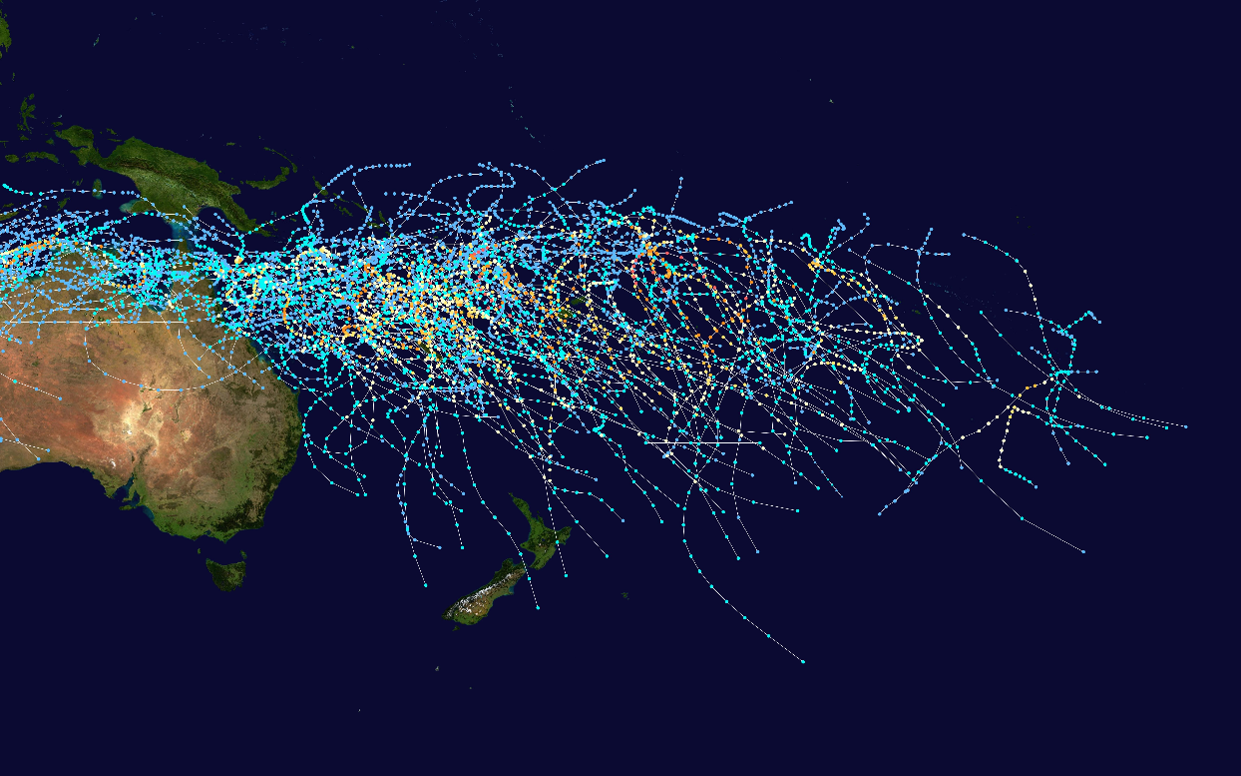
South Pacific map of all tropical cyclone tracks between 1985 and 2005 – courtesy Wikimedia Commons.
How many tropical cyclones can we expect to see?
On average, about 10 tropical cyclones form in the South Pacific tropics between November and April each year, and about one of those will affect New Zealand as an ex-tropical cyclone (most commonly in February or March). Some seasons are more active than others; the 1997-1998 TC season saw 16 named tropical cyclones, while the 2025-2026 TC season only had two.
What do we mean by ex-tropical cyclone?
When a tropical cyclone exits the tropics and encounters cooler waters and strong upper-level winds, its structure starts to change. This process is called extra-tropical transition. Once this happens, we refer to it as an ex-tropical cyclone. For ease of communication, we often drop the ‘ex-tropical’ part; instead of ‘ex-Tropical Cyclone Gita’, we just say ‘Cyclone Gita’.
It’s important to note that the ‘ex’ doesn’t mean the cyclone has weakened. It may still have considerable potential for severe weather, and under the right meteorological conditions it can even intensify. Many of New Zealand’s most severe and impactful storms have been ex-tropical cyclones.
Who is watching for tropical cyclones?
The locations where tropical cyclones are likely to form and/or track through are split into different areas of responsibility. These areas are covered by either Regional Specialised Meteorological Centres (RSMCs), or Tropical Cyclone Warning Centres (TCWCs). Each centre is responsible for issuing warnings and information (such as TC track maps) for tropical cyclones within their area, and if a tropical cyclone forms in their area, they also get to name it.
MetService operates TCWC Wellington, so all official warnings and information about tropical cyclones that could affect New Zealand originate from us.
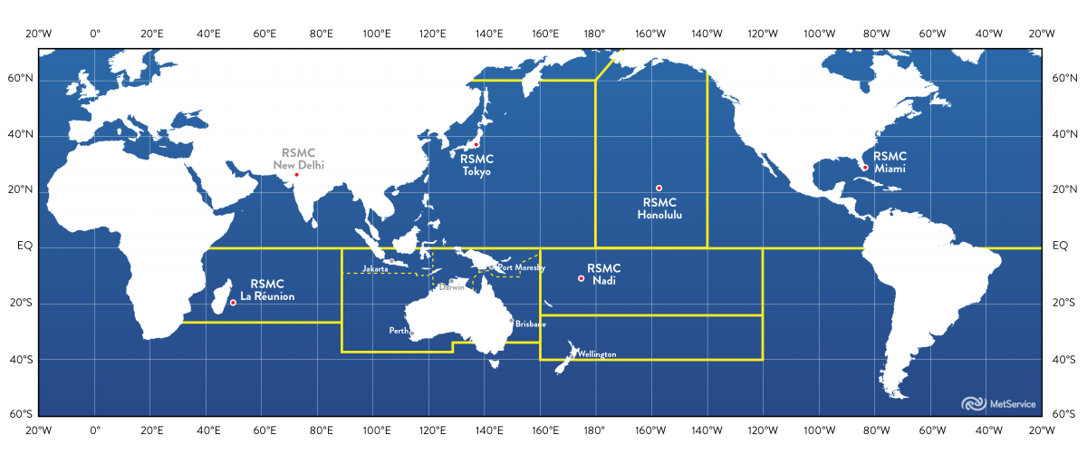
Map of WMO Tropical Cyclone Monitoring Centres