
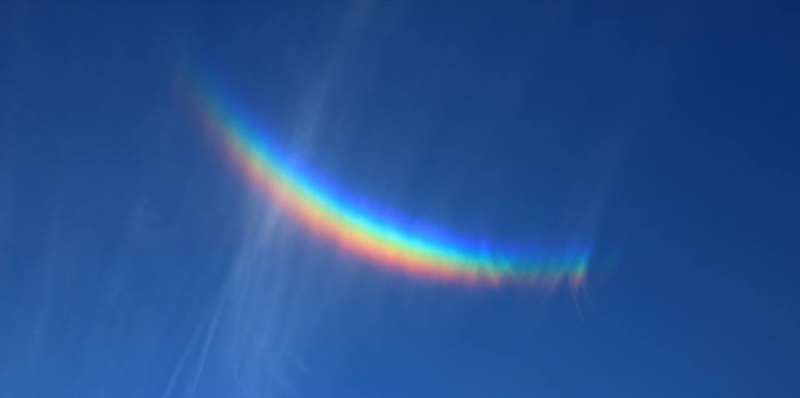
Circumzenithal Arc
Ice crystals can come in many different shapes and sizes. High up in the atmosphere, water can remain in its liquid phase well below 0°C (super-cooled liquid water), and the temperature at which it freezes has a great effect on the shape of the resulting ice crystal.


Cloud Irisation
Cloud irisation (also called iridescence) is caused by sunlight diffracting around cloud droplets. Diffraction is the bending of light as it passes between small gaps or past edges. For this to occur, the cloud droplets must be of a similar size to the wavelength of light.

Anti-Crepuscular Rays
Anti-crepuscular rays are similar to crepuscular rays, except you must be facing away from the sun to see them.
Like crepuscular rays, they are usually seen at sunrise and sunset, and the rays are formed by the sun shining between clouds.

Crepuscular Rays
Crepuscular rays (sometimes called Sun rays, God rays or Jacob’s Ladder) are rays of sunlight that are seen when the sun is partially obscured by cloud.


Valley Fog
Valley fog is another special case of radiation fog. The formation process also relies on the land surface cooling by emitting radiation to space, allowing the air to reach its dew point temperature and causing moisture to condense.

How to read weather maps
Weather maps as they appear on TV, in a newspaper or here are called 'surface charts' or, more correctly, 'Mean Sea Level' (MSL) charts. They show what is happening at a set time where most of us need it - at the Earth's surface.

Radiation Fog
Radiation fog usually forms overnight or early morning during the coldest hours of the day, and then dissipates after the sun comes up. It primarily forms over land but has been observed to form over shallow inlets and harbours as well. It is the most common type of fog we see in New Zealand
